
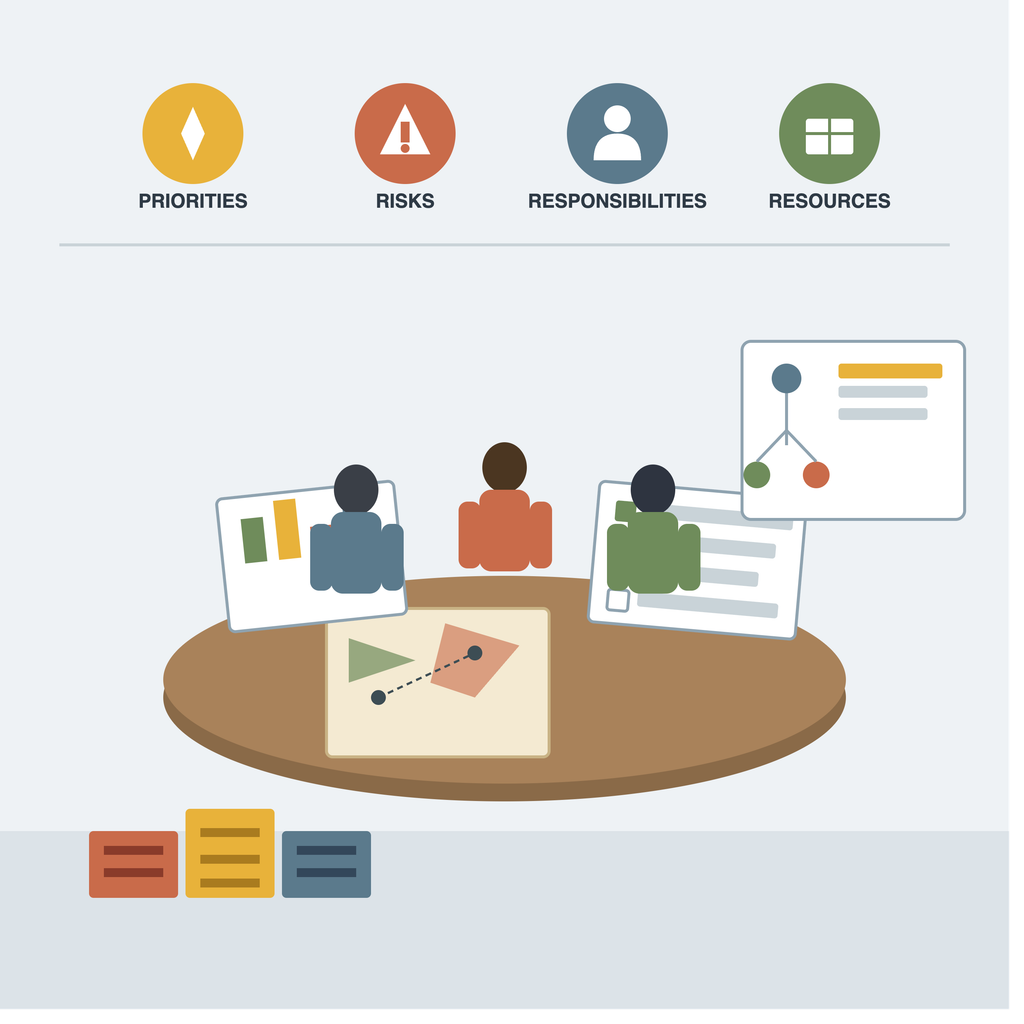
Emergency planning is more than creating a document and putting it on a shelf. An effective emergency plan is a living process designed to help people understand risks, make informed decisions, respond effectively, and recover from emergencies.
Whether the plan is for a family, business, nonprofit organization, or community, the fundamental objective remains the same: protect people, reduce risk, and provide clear actions when normal operations are disrupted.
Start With the Right People
An effective plan begins by identifying the people who should be involved in developing and maintaining it.
For a family, this may be family leaders who understand the household’s needs, responsibilities, resources, and limitations.
For a business or organization, planning should involve key personnel and leadership who understand the organization’s operations and can make decisions during an emergency.
Larger community and government planning efforts may require participation from a broader range of professionals, including:
- Leadership and government officials
- Emergency management and emergency responders
- Medical professionals
- Legal professionals
- Communications specialists
- Logistics and transportation professionals
- Engineers and technical specialists
- Business and community leaders
- Other subject-matter experts
The goal is not simply to have more people involved. The goal is to have the right knowledge and decision-making capabilities represented in the planning process.
Make Safety the Primary Function
The primary purpose of emergency planning is to protect life and safety.
A useful plan should identify hazards and risks and establish clear, actionable procedures for addressing them. It should also consider the activities that must take place before, during, and after an emergency.
Planning should address areas such as:
- Hazard identification and risk assessment
- Emergency response
- Protective actions
- Communications
- Resources and logistics
- Mitigation
- Continuity of essential functions
- Recovery
A plan should answer an important question:
“What do we need to do when something goes wrong?”
The answer should be practical enough that people can use the plan under stressful and rapidly changing conditions.
Plans Must Be Reviewed and Updated
One of the biggest weaknesses in emergency planning is allowing a plan to become outdated.
Organizations, families, communities, personnel, facilities, equipment, technology, and risks all change over time. A plan that was appropriate several years ago may no longer address current conditions.
Establishing a regular review schedule helps keep the plan relevant.
An annual review or audit can provide an opportunity to evaluate:
- Changes in hazards and risks
- Changes in personnel and responsibilities
- Contact information
- Available resources
- Communications procedures
- Facilities and equipment
- Emergency procedures
- Lessons learned from previous incidents or exercises
Plans should also be reviewed whenever significant changes or new risks are identified. Waiting for the next emergency to discover that a plan is outdated is not preparedness.
Build Flexibility Into the Plan
Emergency situations rarely unfold exactly as expected.
New information may become available. Hazards may change. Resources may become unavailable. Personnel may not be able to report to their normal locations. Communications systems may be disrupted.
For these reasons, an emergency plan should be designed so that it can be modified as situational awareness develops.
This does not mean constantly changing the entire plan. It means establishing a framework that allows decision-makers to adapt procedures and priorities when circumstances require it.
A strong plan provides structure while allowing responsible people to make informed decisions based on current conditions.
Training and Awareness Are Part of the Plan
A plan is only as effective as the people expected to carry it out.
Simply distributing a document does not ensure that people understand their responsibilities.
Training and awareness should therefore be incorporated into the planning process. Depending on the organization and its needs, this may include:
- Employee or family preparedness education
- Emergency procedures training
- Communication exercises
- Tabletop exercises
- Drills and practical exercises
- Review of individual responsibilities
- After-action evaluations
- Ongoing preparedness awareness
Training also provides an opportunity to identify weaknesses in the plan before an actual emergency occurs.
Emergency Planning Is an Ongoing Process
Preparedness is not a one-time project.
Effective emergency planning involves a continuous cycle of assessing risk, developing plans, training people, evaluating performance, and making improvements.
The objective is not to predict every possible emergency. It is to build the capability to respond when circumstances are uncertain.
A well-developed emergency plan gives people something valuable when an emergency occurs: a starting point.
That starting point can help reduce confusion, establish priorities, protect people, preserve essential functions, and support recovery.
Preparedness Builds Resilience
Emergency planning and resilience go hand in hand.
The better prepared individuals, families, businesses, and communities are before an emergency, the better positioned they are to withstand disruption, adapt to changing conditions, and recover afterward.
Preparedness is not about expecting the worst. It is about being ready for what could happen.
At Gulsby Consulting, our approach to preparedness focuses on practical planning, risk awareness, resilience building, and developing plans that can be understood, used, reviewed, and improved over time.
Douglas Gulsby BS-HSEM